fot Athéon
fot Athéon
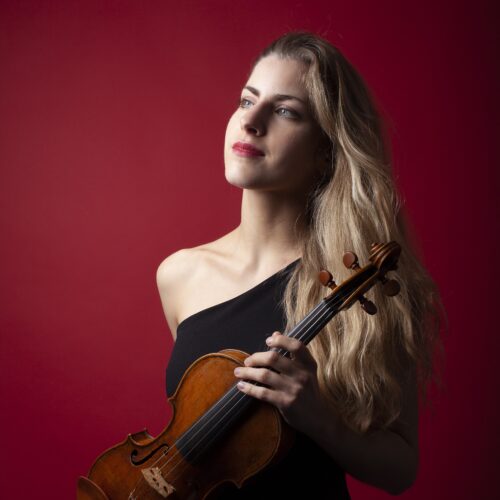
Manon Galy violin
Arielle Beck piano
Gabriel Fauré Violin Sonata No. 1 in A major, Op. 13 [25’]
I. Allegro molto
II. Andante
III. Scherzo: Allegro vivo
IV. Finale: Allegro quasi presto
César Franck Violin Sonata in A major, FWV 8 [27’]
I. Allegretto ben moderato
II. Allegro
III. Recitativo-Fantasia: Ben moderato – Molto lento
IV. Allegretto poco mosso
In the 19th century, the salons of the Parisian aristocracy, bourgeoisie, and even the middle class resounded with music. People gathered around the piano or to listen to chamber ensembles. Performing and listening to music – and then discussing it – was considered good form and was part of everyday life; at times, it even found its way into literature. And this was by no means merely a decorative element: in Marcel Proust’s gargantuan series In Search of Lost Time, music plays a fundamental role, especially a phrase from a sonata for violin and piano by a certain Vinteuil (whose name the author never reveals, but who is known to have also written a septet). Vinteuil is a fictional character, and his works belong to that category of famous compositions that exist only in literature – alongside Adrian Leverkühn’s Apocalipsis cum Figuris in Thomas Mann’s Doctor Faustus or Boris Groen’s ballet The Giant in Agatha Christie’s Giant’s Bread, written under the pseudonym Mary Westmacott. Nevertheless, attempts have been made to determine which real works might have inspired Proust. Among the leading candidates are the Sonatas in A major by Gabriel Fauré and César Franck. The latter is a particularly good fit – Swann, Proust’s protagonist, notes a phrase present in every movement, and Franck’s Sonata in A major is held together by a recurring theme. For Swann, music also has the same power as the famous madeleine – that of evoking memories. The concert by Manon Galy and Arielle Beck, meanwhile, will evoke the atmosphere of a French salon – and who knows, perhaps even the spirit of Proust?
– Dominika Micał (pisanezesluchu.pl)