Franciszek Wybrańczyk
Born 28 May 1934 in Studzienice, deceased 31 May 2005 in Warsaw. He was a clarinetist and an active member of both the Polish and European music communities, popularizing Polish music abroad. He co-founded and headed the Sinfonia Varsovia orchestra.
In 1975 Franciszek Wybrańczyk, a long-time musician of the Polish Radio and Television Orchestra in Warsaw, joined the Polish Chamber Orchestra, which was then considered both at home and abroad to be among the best Polish orchestras. Initially he worked as an assistant and aide to conductor Jerzy Maksymiuk, moving up to the post of orchestra director in 1978.
“His inventive approach to organization and the ease with which he commanded the ensemble brought together things that might otherwise have shattered into exceptional individuals, much like the shapes in a kaleidoscope shatter into colorful beads,” said Jerzy Maksymiuk about Franciszek Wybrańczyk.
In 1984 he founded, together with Waldemar Dąbrowski, the Sinfonia Varsovia orchestra by expanding the Polish Chamber Orchestra. He became its leader and artistic director. During his many years of work he always ensured that the orchestra maintained artistic integrity. He initiated collaborations with brilliant conductors and solo artists and organized tours which brought the orchestra to the best concert halls in Europe, Japan, and the Americas.
In 2001 he initiated and became the artistic director of the Sinfonia Varsovia to Its City Festival. The event is a prominent feature of Warsaw’s cultural landscape thanks to its high artistic standards and popularity among local concertgoers. The festival continues to live on.
For his contributions to the field of musical culture, he was awarded the Order of Polonia Restituta Commander’s Cross, the Badge of Honor for Service to Warsaw, and the Medal for Merit to Culture – Gloria Artis (posthumously).
“An Ordinary Extraordinary Man” – Franciszek Wybrańczyk in the memories of musicians
Francesco – that is what the world’s most renowned artists called him. To me, he was my clarinet teacher in school, and later a charismatic director and mentor. I often ask Mr. Wybrańczyk in my mind what decision I should make. I consider the years I spent working with this legend to be an invaluable part of my life.
I had known Mr. Wybrańczyk for a long time before I joined the orchestra. He was my clarinet teacher – he still found time to teach at the school while serving as the director of the Polish Chamber Orchestra and, later, Sinfonia Varsovia. I remember his stories from that time about tours with the orchestra, about magnificent performances that I didn’t even dare to dream of back then. Mr. Wybrańczyk was an excellent teacher, and I – perhaps not quite a good student (probably because I once got a guinea pig to which I was allergic, and it was hard for me to practice playing a wind instrument). One day he told me: “You know what, you’re not going to be a clarinetist. Your only chance to become a musician is the double bass.” I broke out in a cold sweat: I wasn’t very interested in that instrument at the time, and there were only two years and a few months left until the university entrance exams. Mr. Wybrańczyk paid no attention to my anxiety and took me to a double bass teacher, who stated that learning to play a completely new instrument – and a stringed one at that – in such a short time was impossible. I, however, was determined; I practiced for several or even a dozen or so hours a day, and after about two weeks, I fell in love with the double bass – a love that continues to this day.
A few years later, when I was in my fourth year of studies, Mr. Wybrańczyk called me and said, “We’re holding an audition for a double bassist for our orchestra, so why don’t you come and play? I hear you’re a good player.” I took the audition with absolutely no confidence, and – surprisingly – I passed. Suddenly, I became a full-fledged, permanent member of Sinfonia Varsovia, which I really couldn’t wrap my head around at the time. I got to play with these outstanding artists: Menuhin, Rostropovich, Penderecki, travel all over the world, and perform on the biggest stages. And Mr. Wybrańczyk became for me not only a professor and mentor, but also – a director.
A remarkable figure – a charming gentleman with a gray goatee, always elegant in a suit, and fluent in many languages. His impeccable manners were truly irresistible. He was charming, charismatic, and had a knack for making everyone laugh. The musicians placed great trust in him: they believed that all his artistic and managerial decisions were absolutely the best. An unrivaled authority.
Throughout my life, including the private one, Mr. Wybrańczyk made many decisions that didn’t seem entirely wise to me at first, but they all turned out to be for the best. He was my artistic father, my mentor, my boss – a man who taught me so much.
– Janusz Marynowski, Director of Sinfonia Varsovia
They say no one is irreplaceable – I disagree, Franek is irreplaceable.
I remember Franciszek Wybrańczyk as someone who held the ensemble together – he was the orchestra’s main pillar. Of course, he could be unpleasant when someone broke basic agreements, violated the rules, or failed to maintain discipline. Nevertheless, he was also understanding and could laugh at himself. To this day, many stories about him circulate in the orchestra. In fact, it was he who, building on the foundation of the Polish Chamber Orchestra, created an institution that continues to grow and operate to this day – and it is called Sinfonia Varsovia.
– Jacek Nycz, viola
He respected every musician. He was demanding – but respectful. He had a gift for persuasion and for convincing others of his point of view.
– Łukasz Turcza, violin
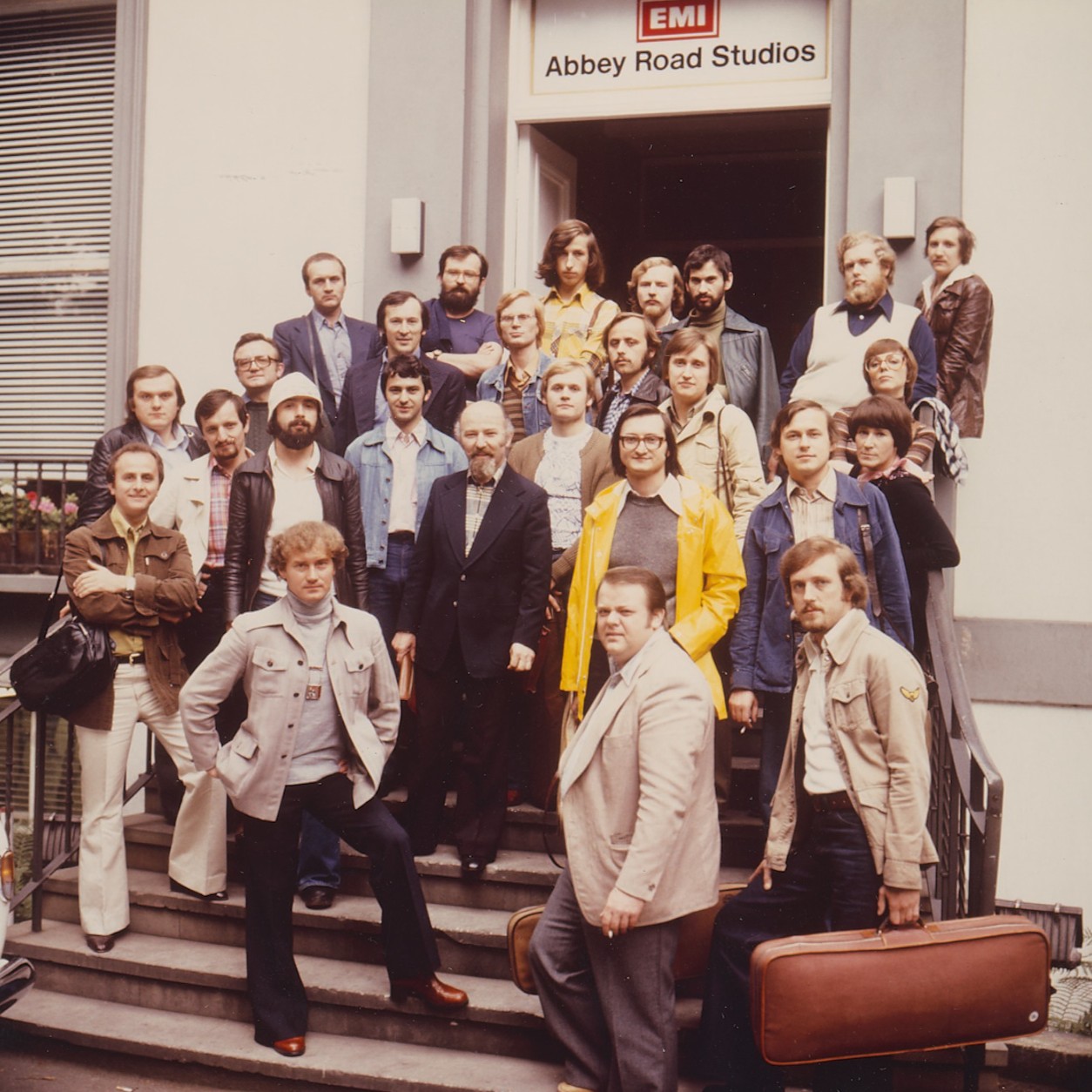
Polska Orkiestra Kameralna, Londyn, 1979 fot. Roy Round
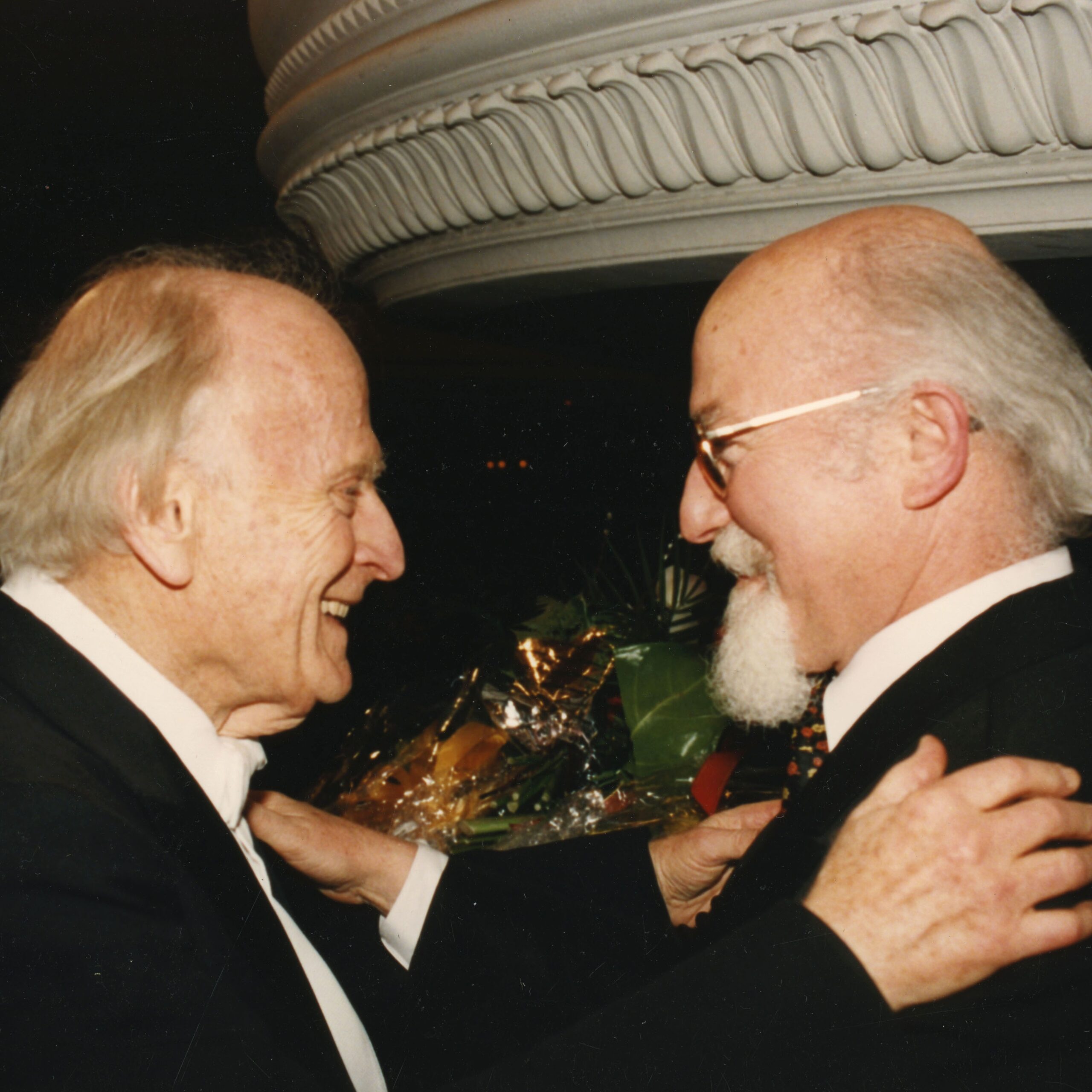
Od lewej: Yehudi Menuhin i Franciszek Wybrańczyk, fot. Piotr Rogóyski
A very well-organized man, devoted to the orchestra. He was with us on the bus and on the plane; at concerts and at rehearsals. He would sit next to us and listen (and, at the same time, check to see if everyone was in good shape). For him, everything had to be 100%.
The director once asked me, while we were on tour, if I played Mozart’s Concerto for Oboe and Orchestra. I replied, “Yes, but the festival is in two months, and we’re on the road the whole time. I don’t know when I’ll have time to prepare.” And the director said, “Do you know the score?” – “I do.” – “Well then, you’ll play.” And I did play, performing several concerts at a festival in Spain as a soloist.
– Adam Szlęzak, oboe
He refused to accept that something was impossible. He was a demon for work; everything was perfectly organized from start to finish.
I remember something that happened to us once at an airport in France. We were taking the elevator to another floor, and Mr. Wybrańczyk had his “office” with him – a large bag containing a notebook with all his handwritten contacts, a phone, and some old computer. He calmly put his “office” next to the double bass. In the meantime, the elevator stopped, one man got off, and we continued on. When we reached the exit, it turned out the “office” was gone. The man who had been with us in the elevator must have taken it. The whole orchestra started running around the airport – everyone who could was looking for the missing bag. I had never seen Mr. Wybrańczyk so panicked in my life – he looked as if the whole world had collapsed. Fortunately, by some miracle, the office was found on another floor, and that’s when Mr. Wybrańczyk came back to life – and from then on, we kept our eyes peeled at all times.
– Roman Sykta, French horn
For us, the most stressful month every year was April. We were usually abroad at that time, and during the break before a concert or between rehearsals, we would sit in the cafeteria, and Franek would come over with a special notebook where he jotted down his comments. Every year, everyone – regardless of whether they had been with the orchestra for 5 or 10 years, or whether they were a tutti player or a concertmaster – had to go through this review of the past year and hear from Franek: “I look forward to seeing you next season.”
Franek once said he wouldn’t fire anyone from the orchestra. The selection process was very demanding, but if someone passed the probation period and fit in with the ensemble, it was clear they would be playing with us for the long haul.
When I first started out, I wasn’t just a timpanist – I was also a truck driver, working alongside Janusz Czyżewski and later with Rysiek Dembicki. After a whole night on the road, I had to quickly switch to being a musician and show up for a rehearsal. The rest of the orchestra flew by plane, so they were well-rested, but I was often tired and not fully focused. We were playing Beethoven’s Symphony No. 3 with Menuhin at the time, and at one point, still on the first page of the score, I blundered into a rest. Quite spectacularly, in fact – the timpani could be heard throughout the hall, and everyone was in stitches. And then I heard a voice from the back: “Mr. Kostrzewa, we don’t make mistakes in this orchestra.” I froze, but when I turned around, there was no one there. Franek had a knack for appearing out of nowhere, delivering a punchline, and vanishing. I still remember it to this day, and ever since then, whenever we play the “Eroica,” I know that at that point I have to count precisely, because in our orchestra, there are no mistakes.
He was a professor at a music high school and the head of the wind instruments department. He knew all of us from school and later scouted out certain individuals, inviting them to join the orchestra – at first as guest musicians. I performed my graduation recital the same year as Hanka Turonek; after the recital, he came up to us, congratulated us, and said: “You must be hired [Ms. Turonek], and I’ll see you in my orchestra too, in a few years [Mr. Kostrzewa]”
– Piotr Kostrzewa, timpani
A cultured man, a fantastic manager and organizer. A connoisseur of people. A truly remarkable person.
He was very demanding, but he also knew how to appreciate the musicians. After every concert, he would come over to us, shake everyone’s hand, thank us, and congratulate us.
Nothing was impossible for him – he had a talent that allowed him to handle anything. Even if something had to be organized on short notice, 15 minutes was all he needed to find a solution. There were times when, for example, a flight was canceled and we had a concert scheduled. He could handle it so that we made it right on time, and we walked onto the stage almost with a police escort.
– Paweł Szczepański, French horn, staff member of Sinfonia Varsovia, former member of the orchestra
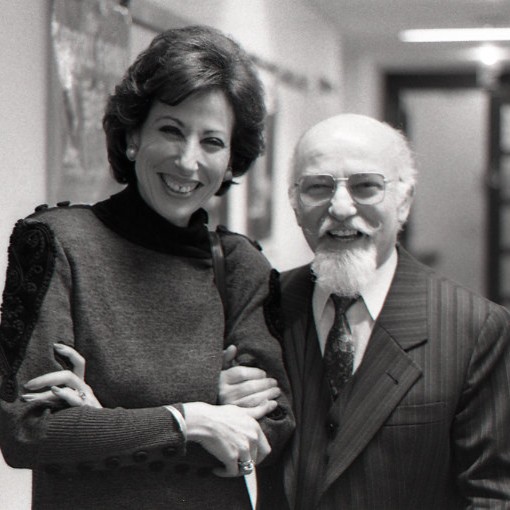
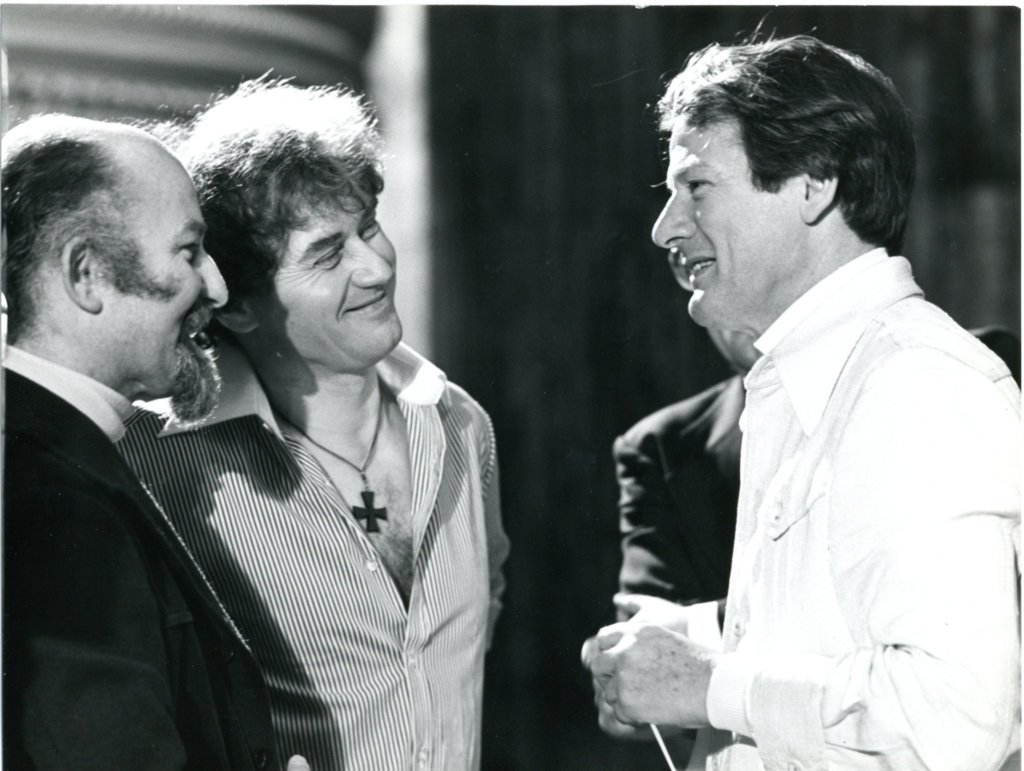
Eleanor Hope i Franciszek Wybrańczyk, fot. Janusz Marynowski
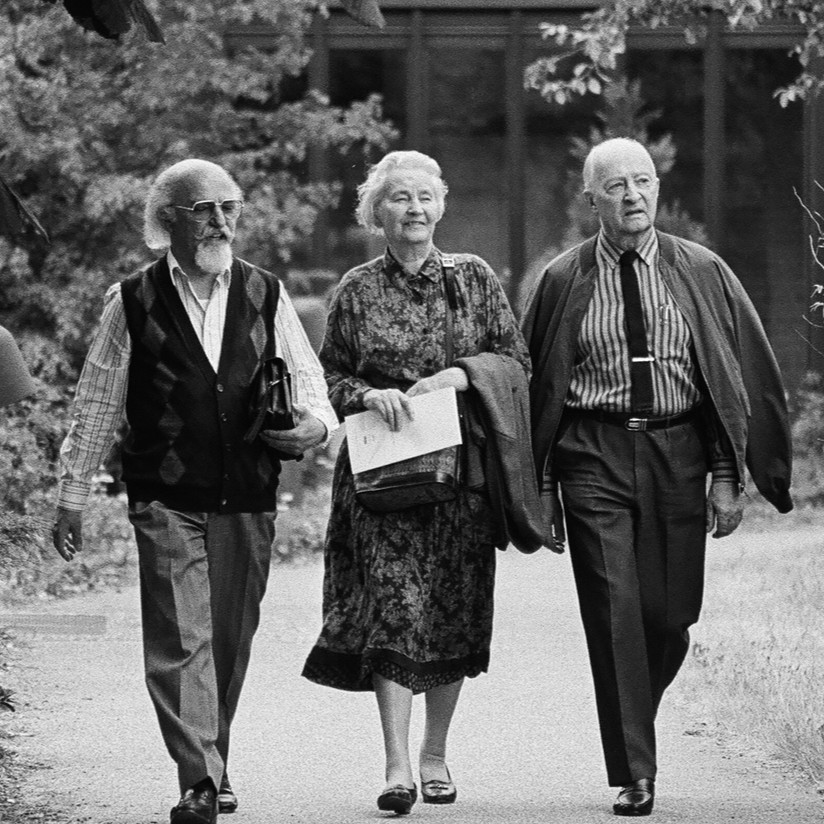 Od lewej: Franciszek Wybrańczyk, Danuta Lutosławska, Witold Lutosławski, fot. Janusz Marynowski
He was a gentleman; he took special care of the women in the band. He would often come up to us and ask, “How are you feeling? How’s it going for you in the orchestra?” Once, on a day off, Ania Gotartowska and I went out to lunch together. We ran into Frank at the restaurant, and he immediately offered us dessert and coffee.
He knew me from back when I attended the Music High School on Krasińskiego Street; he taught clarinet there and would come to the midterm exams. When I was a student at the Academy of Music – I was in my third year at the time and had just returned from a competition in Italy where I had received an honorable mention – he called me and said: “Hello, this is Wybrańczyk. Would you like to try out for our orchestra?” I tried out, and that’s how it stayed.
In the early 1990s, Sinfonia Varsovia’s concerts were frequently broadcast on television. One time I was sitting at home, watching our concert with my then-fiancé, when suddenly the landline rang (after all, cell phones didn’t exist back then). I answered, and it was Franek: “Ms. Turonek, are you watching TV? They’re showing you right now! Oh, now I can see your fingers – those are your pink nails.” And so we had a nice little chat.
One time, I missed my flight to France. The orchestra’s office was located at the Studio Art Centre at the time, and we were just about to leave for Nantes in two groups: most of the orchestra had flown to Paris two or three days earlier for a recording session, and I was supposed to join them later along with a few others. Wybrańczyk appointed me as the group leader and told me to pick up tickets for everyone from the office. However, Marek Żwirdowski, who happened to be at the Studio Art Centre, called me to say he could pick up the tickets right away and was heading to the UMFC [The Chopin University of Music] afterward – I live nearby, so I went down to see him for a moment and picked up my ticket. Marek appointed himself as the group leader – fortunately, as it turned out later.
The next day, our flight to Paris was scheduled for an ungodly hour – 6:00 or 7:00 in the morning. I had a small child at the time and hadn’t traveled in a long while, so I accidentally set the alarm an hour too late. When I arrived at the airport, the gate had been already closed. Terrified, I called Franciszek and explained the whole situation. And he – unlike him – with a fatherly calm in his voice: “Ms. Turonek, please take a later flight; we’ll wait for you.” I managed to rebook my ticket at no extra cost; I even had time to go home, take a shower, and eat breakfast. And in Paris, everyone had to wait for me for about two hours before leaving for Nantes.
– Hanna Turonek, flute
He was very charismatic and had a great deal of charm. Though, of course, he could also be strict at times. He always sensed exactly what the orchestra needed at any given moment – whether it was praise or some other form of encouragement.
He cared deeply about the orchestra’s performance. He often said that people “listen” with their eyes as well, and he was very particular about maintaining proper posture at the instrument. He frequently attended rehearsals without neglecting his other duties. We performed almost all over the world. Even on a beach in Mexico. Or on board a flying plane with pianist Justus Frantz (the piano was there too, of course, secured to the floor), or on the open sea on a ship, with the biggest stars of the music world. The director wasn’t afraid of such challenges, which allowed us to establish contacts and collaborate with the world’s leading agencies, perform in the most prestigious concert halls with the finest conductors and top soloists.
He also had an incredible knack for connecting with people – whether it was the cashier or top executives. I remember once when we were on a cruise with the orchestra, and there was a well-known manager there. I saw him throw his arms around Franek’s neck, shouting, “Francesco!” People simply adored him. He was the kind of person who instantly connected with everyone.
Back then, we rarely played in Poland; we mainly performed abroad. There were times, however, when we would come back from a tour for just one day – flying in at 5:00 AM to play that evening at the Warsaw Autumn festival, and then flying right out the next day to continue the tour. For him, nothing was impossible; that word didn’t exist in his vocabulary. He could handle anything, always looking for solutions right away – that was just his nature. […] As the director, he always stayed until the very end to make sure everything was taken care of.
When I went on my first tour with the orchestra – a six-week trip – I was really nervous about it. Back then, there were no suitcases with wheels – you just had to carry a huge bag in your hands. We arrived at the hotel, and I was the last one to climb the stairs; my room was on the fourth floor. Behind me was only the director, who joined us after he had taken care of everything at the front desk. He saw me with that suitcase – I wanted to manage on my own, but he took it from me and carried it right up to my door. He simply cared for people. We were like his children – that orchestra was his child.
I had the impression that he was simply everywhere. For example, the director would attend concerts at the Academy to listen to young musicians. That’s how my collaboration with the ensemble began. He came up to me after a performance to congratulate me and, while he was at it, ask if I’d like to play in the orchestra. Of course, after that I was evaluated for a long time, tested in various situations and through auditions. The director was simply conducting that initial assessment: who fits into the ensemble, who plays with the kind of energy that would suit Maksymiuk. Sometimes I miss him on a personal level. I think to myself that, in a way, it’s thanks to him that I ended up in this orchestra and that my life turned out the way it did.
Once, while we were on tour, St. Nicholas Day happened to fall during that time. There weren’t many of us women in the orchestra then. And all the girls received a little scarf as a gift. I think it was the director’s idea. Another time, he called us – all the girls – to come on stage during the intermission for a photo with Menuhin. A few days later, December 6th rolled around again, and we all received those photos, developed and framed. And Menuhin wrote something different to each girl on that photo. The director organized it for us, and now we have such a beautiful keepsake.
When we worked with maestro Maksymiuk – both in the Polish Chamber Orchestra and later, for example, during long tours – all sorts of things would happen. The maestro has quite a temper, of course, so sometimes he would simply get upset during rehearsals. And it was usually director Wybrańczyk who calmed him down. More than once, we could see through the window how the maestro was pacing back and forth in the room, speaking animatedly, while the director calmly followed him and soothed his emotions. Calming Maksymiuk down was the ultimate test – he was able to do it; he had the gift of a diplomat, a mediator.
– Anna Gotartowska, violin
I first met Mr. Franciszek Wybrańczyk as an outstanding clarinetist, as that was the role in which he began his collaboration with the Polish Chamber Orchestra after returning from a contract in Lebanon. I joined the ensemble led by maestro Jerzy Maksymiuk as a student in the early 1970s. At that time, we had no idea that someone like Mr. Wybrańczyk would join the orchestra. Aware of his talents, Stefan Sutkowski, then director of the Warsaw Chamber Opera, offered Mr. Wybrańczyk the opportunity to take on the managerial leadership of the Polish Chamber Orchestra. Mr. Wybrańczyk proved to be outstanding in this role.
He had a favorite French saying: “organisation.” He had that organization all figured out in his head. If it weren’t for that, I don’t know if the orchestra would have achieved such results at all, or if Sinfonia Varsovia would ever have been founded. Sinfonia Varsovia was his child. He strove to ensure that the orchestra had its own home and was a national institution, under the patronage of the Ministry of Culture.
He had an excellent rapport with conductors and soloists alike, as well as with directors of artistic agencies around the world. To them, he was simply “Francesco.”
There was a story going around at the Studio Art Centre that whenever Mr. Wybrańczyk was in the thick of his work and needed to call home, he would dial the number and start the conversation with, “Wandzia? This is Wybrańczyk.” He was calling his wife, yet even to her he spoke in such a formal manner.
In the Polish Chamber Orchestra, an addendum to the contract was the so-called “constitution” drafted by Franciszek Wybrańczyk, which outlined the rights and responsibilities of the musicians. For example, we weren’t allowed to be late, attention was paid to concert attire, and we couldn’t forget our sheet music (though, of course, various situations did arise). After a short time, we could truly be held up as a model of punctuality and individual preparation for rehearsals. This also had an impact on the playing itself – great attention to detail and precision.
Francesco was always very elegant – a tie, a white shirt, a jacket. Even when we traveled to places where it was sweltering, he looked impeccable. He enjoyed good food, liked to have a glass of wine now and then, and loved to joke around with us.
He was very devoted to the orchestra – it was the apple of his eye.
An ordinary extraordinary man.
– Grzegorz Kozłowski, violin, former orchestra musician
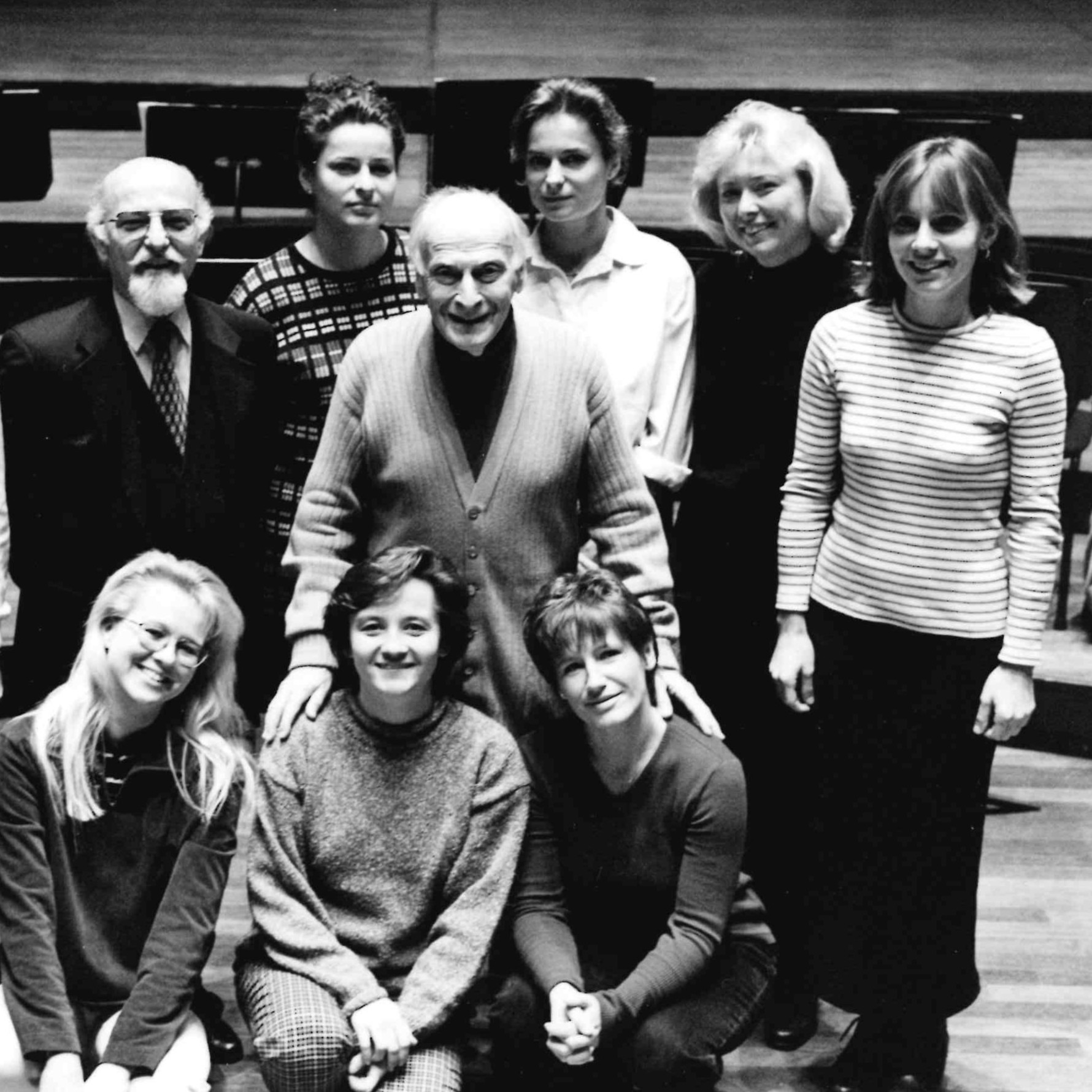
Yehudi Menuhin i Franciszek Wybrańczyk wraz z muzyczkami Sinfonii Varsovii, z archiwum Anny Gotartowskiej
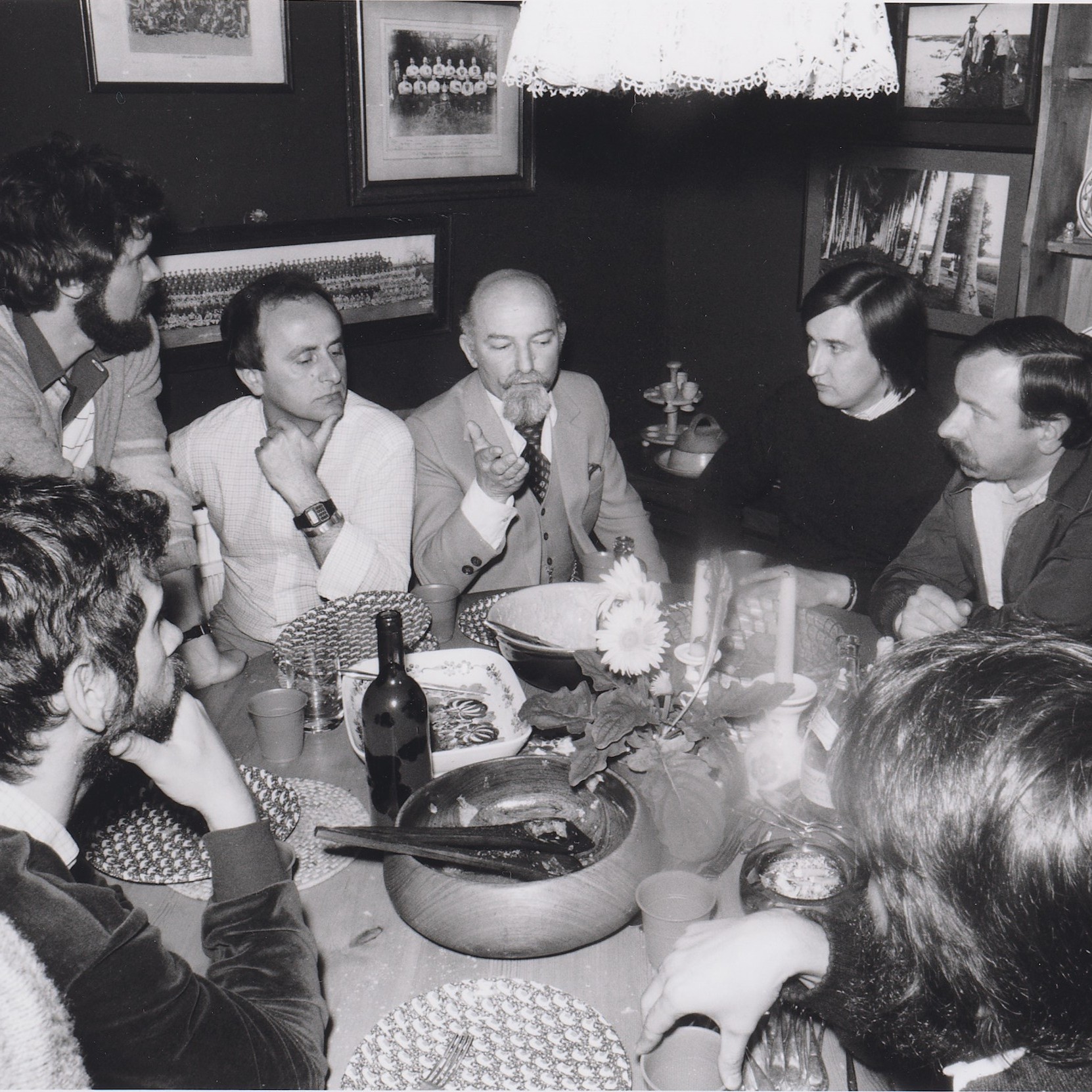 Franciszek Wybrańczyk wraz z muzykami Sinfonii Varsovii, z archiwum Anny Gotartowskiej


